



Emergency Automatic Door Repair: What to Do When Your Commercial Entrance Fails
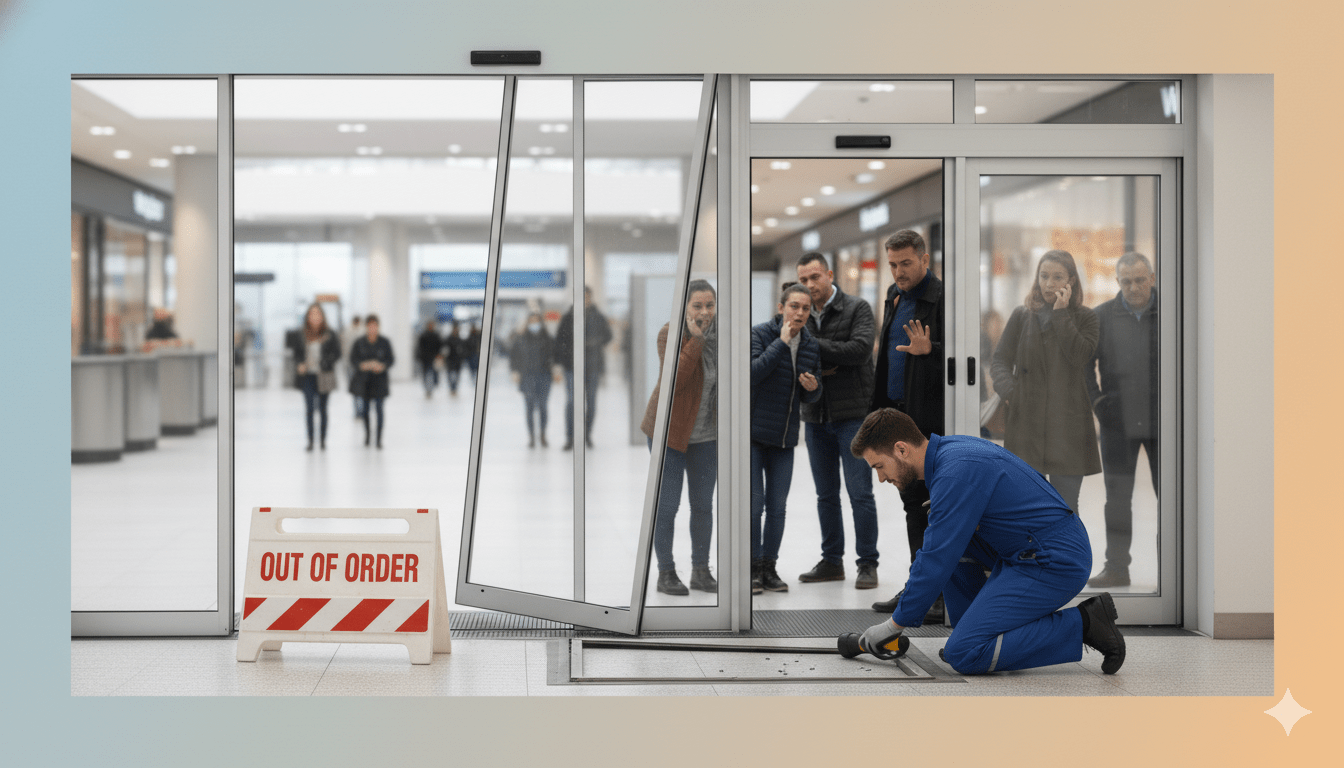
A failed automatic door at a commercial premises creates immediate problems. Customers can’t enter, security is compromised, climate control is affected, and the professional image of your business suffers with every minute the entrance remains inoperable.
This guide explains what to do when an automatic door fails, how to secure a temporary solution, and how to get emergency repairs arranged quickly.
Immediate Steps When a Door Fails
When an automatic door stops working, take these immediate steps to manage the situation:
Ensure safety first: If the door is stuck in a partially open or closed position, or is moving erratically, prevent people from using it. Use barriers or signage to redirect traffic to an alternative entrance.
Try the manual override: Most automatic doors have a manual override that allows them to be locked in the open or closed position, or operated manually. Check your door’s documentation or look for an override switch on the operator unit.
Check the obvious: Before calling for emergency repair, check that the door hasn’t simply been switched off, that no obvious obstruction is blocking the sensors or track, and that the power supply is connected.
Secure the premises: If the door cannot be closed and locked, arrange temporary security measures. This might mean stationing staff at the entrance or, for overnight failures, arranging security patrol or boarding.
Document the fault: Note exactly what the door is doing, or not doing. Any sounds, warning lights, or error messages will help the engineer diagnose the problem faster.
Arranging Emergency Repair
Contact your automatic door maintenance provider as soon as possible. If you have a maintenance contract, you should have a direct number for emergency callouts. Explain the situation clearly: the type of door, what’s happening, any error codes displayed, and the urgency of the situation.
A good service provider will be able to give you an estimated response time. For genuine emergencies during business hours, you should expect an engineer within two to four hours. Out-of-hours callouts may take longer, though many companies offer same-day response even at weekends.
Be aware that emergency callouts typically attract premium rates, especially outside normal working hours. Ask about charges upfront so there are no surprises.
Common Causes of Emergency Callouts
Understanding common causes helps set expectations for the repair:
- Sensor faults: Often repairable on site with parts carried in the service vehicle. Expect a relatively quick fix.
- Motor failure: May require a replacement part that needs to be ordered. The engineer may be able to secure the door manually while awaiting parts.
- Control unit failure: Similar to motor failure, this may need parts. Some control issues can be resolved by resetting or reprogramming.
- Physical damage: Impact damage to door panels, frames, or tracks may require more extensive work or temporary boarding until replacement parts arrive.
- Power supply issues: Sometimes the fault lies with the building’s electrical supply rather than the door itself. An electrician may be needed alongside the door engineer.
Preventing Emergency Breakdowns
While some failures are unavoidable, many emergency callouts result from issues that could have been identified during routine maintenance. A planned preventative maintenance contract significantly reduces the likelihood of unexpected breakdowns by identifying worn components before they fail.
Regular servicing also ensures that your maintenance provider has up-to-date information about your doors, meaning they can respond more effectively if an emergency does occur.
Need Emergency Repair Now?
DAC Automation provides emergency automatic door repair across the Midlands. Our engineers carry common parts in their vehicles and can often complete repairs on the first visit.
Call us now on 01785 617085 for emergency assistance.